
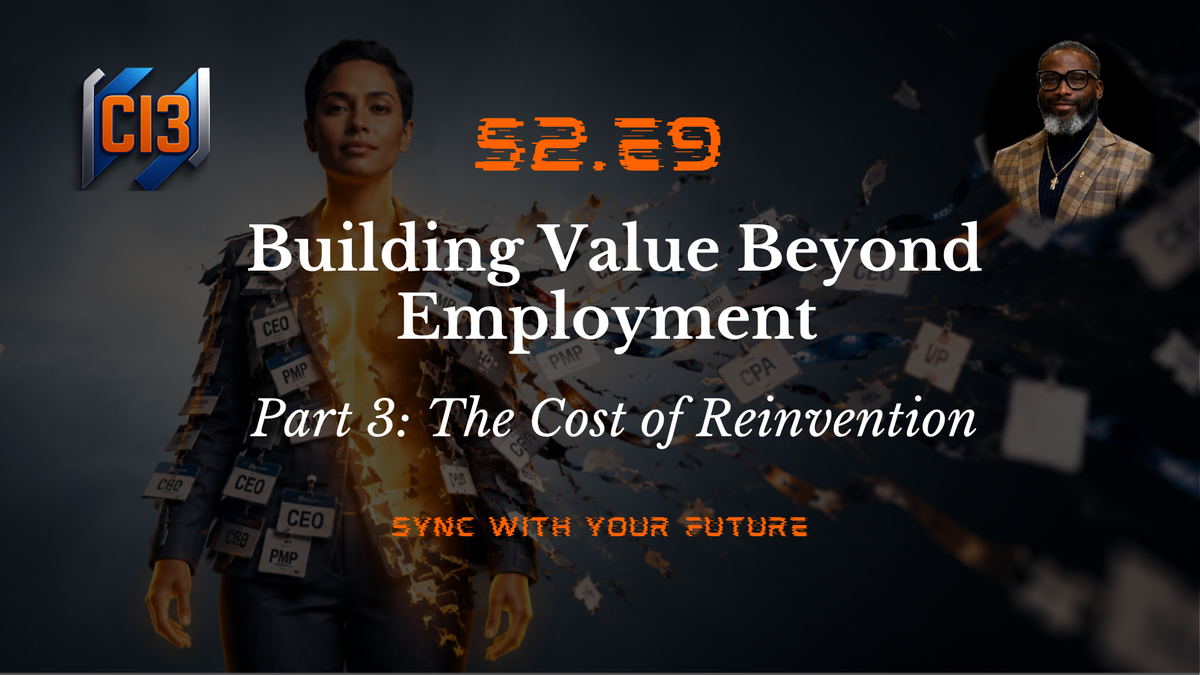
"It is hard work being your true authentic self... that's a risk we take as humans if you want to just get out of that box people have created for us."
Welcome to Part 3 of our four-part series on S2.E9 of the CI3 Fireside Chat: Building Value Beyond Employment with Amy Timmins, Nofal Abdulhadi and Atif Rashid.
In Part 1, we deconstructed the "Title Trap," and in Part 2, we cracked the "Influence Equation" to help you wield executive trust. Today, we confront the raw, unglamorous realities of personal and professional reinvention. Outgrowing your old professional identity is not a clean, seamless transition. It is messy, it upsets the people around you, and it requires you to re-evaluate the heavy cost of the resilience you have been forced to build.
Opening Moment: Breaking the Box
During the live session, Atif Rashid shared an incredibly vulnerable truth about his transition from a traditional CPA to a global keynote speaker. He confessed that his family struggled deeply to comprehend the new version of him. They loved him fiercely, but they wanted the old Atif back, the one who simply went to work from 9 to 5, came home, washed the dishes, and fit neatly into a predictable box. When you decide to build value beyond your standard employment and step into your authentic purpose, you force the people around you to adjust to a new dynamic. Growth is disruptive, and reinventing yourself will inevitably cause friction with those who were most comfortable with the older, smaller version of you.
1. The Myth of "Overcoming"
In modern corporate culture, we romanticize resilience. We love a triumphant narrative where a professional battles through a massive crisis, saves the project, and emerges completely unscathed and victorious. As I mentioned during the chat, we readily celebrate a project coming in under budget, but we rarely pause to ask what the team lost, in terms of burnout, sanity, or family time, to gain that extra dollar.
Atif challenged the entire concept of this sanitized resilience. He noted that the societal pressure to simply "overcome" trauma or adversity is overwhelming and ultimately destructive. The reality is that you do not magically erase the heavy things you survive; you absorb them. True executive maturity is not pretending you are untouched by professional or personal trauma, but developing the self-awareness to recognize when you are responding to your past scars rather than the present situation.
"I learned that hard way that there's no such thing as really overcoming. Whatever we go through in our lives, it becomes part of who we are or who we become... this pressure of overcoming was becoming too much. This word overcoming is just overrated." - Atif Rashid.
Insights 🔎:
- Corporate environments frequently weaponize "resilience," expecting employees to endure systemic dysfunction without acknowledging the psychological toll it takes.
- Believing you must perfectly "overcome" your past failures sets an impossible standard; true leaders carry their scars and use them to build deeper empathy.
- Under high stress, professionals often unconsciously react to past organizational trauma rather than objectively managing the immediate crisis in front of them.
Actions 🛠️:
- Reflect on a major professional crisis you survived and write down two specific leadership biases or triggers you developed as a direct result of that stress.
- When debriefing your next successful project, mandate a team discussion on what the team sacrificed to hit the deadline, not just what they achieved.
Quick Win ✅:
- Stop using the phrase "bouncing back" when describing a team's recovery from a failure, replacing it with language that acknowledges their adaptation and growth.
2. Rejection as Redirection
Even when you build your credentials perfectly, master your domain, and execute flawlessly, the corporate ladder will inevitably reject you. Nofal Abdulhadi joined us in the live chat to address this painful reality. As a highly successful executive overseeing massive national energy infrastructure, he acknowledged that the sting of a closed door never truly loses its bite.
He recalled a specific moment when he was passed over for a leadership opportunity that he fundamentally believed he had rightfully earned. It is a devastating blow when you play by all the institutional rules, only to have the institution decide you are not the chosen one. However, Nofal noted that clinging to the bitterness of that rejection blinds you to the fact that the closed door is actively forcing you off a stagnant path and redirecting your energy toward a much larger, unforeseen platform.
"Being passed over for a leadership opportunity I believed I had earned hurt more than I admitted. But it taught me that rejection can sometimes redirect you toward something bigger. My message: Rejection can be redirection." - Nofal Abdulhadi
Insights 🔎:
- The pain of professional rejection is intensely magnified when you mistakenly tie your entire intrinsic worth to the validation of a single promotion.
- An institutional rejection is rarely an objective measure of your true capability; it is often just a misalignment of internal political timing.
- Leaders who rapidly process their rejection and pivot their strategy consistently outperform those who waste years trying to prove the initial rejector wrong.
Actions 🛠️:
- Conduct a "Rejection Post-Mortem" on a recent missed opportunity to identify exactly which new skills or networks you were forced to build as a result of that failure.
- Identify one career path you are currently clinging to simply out of stubbornness, and map out one alternative direction that might offer a higher strategic ceiling.
Quick Win ✅:
- Reach out to a mentor today and share a past rejection you normally hide, actively framing the story around the specific pivot it forced you to make.
3. From Being Known to Knowing
Early in our careers, we are heavily incentivized to chase visibility. During the panel, I confessed that fifteen years ago, I was fiercely driven by the desperate need to be known. I wanted everyone to know about Charles; I wanted the accolades, the recognition, and the spotlight. I equated external validation with professional success.
But the pursuit of pure visibility without underlying substance eventually turns you into a hollow executive. Over time, I had to completely dismantle that mindset. I realized that aggressively trying to force people to notice you is an exhausting, losing game. The true turning point in building lasting value is shifting your energy away from "who knows you" and pouring it obsessively into mastering "what you know". When you become an undeniable authority in your space, the visibility naturally follows the competence.
"15 years ago, I was fiercely driven to be known... Now the question is, how much do I know rather than who knows you? Because again, it is what you know that is a precursor to you being known." - Dr. Charles Igwe
Insights 🔎:
- Chasing visibility before you have mastered your craft creates a superficial professional brand that crumbles under complex executive scrutiny.
- Desperation to be recognized often projects insecurity to senior leadership, while quiet mastery projects undeniable authority.
- Deep, rare expertise serves as an organic magnet for high-level networks, permanently eliminating the need to relentlessly self-promote.
Actions 🛠️:
- Shift 50% of the time you currently spend on self-promotion or networking into deep, uninterrupted study of an emerging trend in your industry.
- Audit your personal brand pitch: rewrite it to focus entirely on the specific, complex business problems you are capable of solving, rather than the titles you have held.
Quick Win ✅:
- Unsubscribe from two superficial networking groups today and replace them with one highly technical or strategic industry publication.
4. The Ultimate Bet
Building a high-value career often comes with a toxic, hidden tax on your personal life. Amy Timmins shared an incredibly raw account of her time commuting to Silicon Valley, working grueling 60-to-70-hour weeks at Facebook while her husband stayed home with their young twins. She eventually suffered a severe bout of clinical burnout because she refused to reduce her workload or establish any boundaries.
It took transitioning to a smaller startup and hearing her seven-year-old daughter say, "Mommy, I'm so glad you're home now," to shatter her corporate illusion. That moment forced her to radically rebuild her approach to work, permanently enforcing boundaries that allowed her to be present. When she later contemplated leaving the financial safety of big tech to start her own consulting business, her husband provided the anchor she needed, reminding her that the safest investment you can ever make is betting entirely on your own capability.
"...I had a conversation with my husband... and he looked at me and he said, I will always bet on you over anything else. And so what I will tell everyone else is bet on you, you are bet on yourself." - Amy Timmins.
Insights 🔎:
- The corporate culture of "drive at all costs" will gladly consume your personal relationships and physical health if you refuse to enforce strict boundaries.
- You cannot sustain executive value if you are clinically burned out; boundaries are a core requirement for long-term strategic performance, not a weakness.
- Leaving the golden handcuffs of a prestigious corporation requires the profound courage to trust your own intrinsic value over an employer's stock options.
Actions 🛠️:
- Define your absolute "hard stop" working hour for this week, communicate it clearly to your team, and log off without apology when that minute hits.
- Calculate the exact financial and emotional cost you are currently paying to remain in a role that violates your core personal values.
Quick Win ✅:
- Schedule a 15-minute meeting with yourself today to outline the very first step you would take if you were forced to launch an independent consultancy tomorrow.
Closing Note
Reinventing your professional identity requires you to burn the old blueprints. It means accepting that true resilience isn't glamorous, rejection is a necessary redirection, and deep mastery is far more valuable than cheap visibility. When you finally stop seeking permission from the corporate structures that box you in, you free yourself to make the greatest wager possible: betting entirely on yourself.
👇 Are you outgrowing your current scorecard? Don't stay trapped in a role simply because it is comfortable. Run your professional strategy through the Competence Trap Wheel to expose your executive blind spots and discover what you are truly capable of building: https://competencetrapwheel.ci3pro.ca/
Next up in Part 4: In our grand finale, we will explore how to escape the competition by fully embracing your authenticity, why you must go out and "practice" your purpose on strangers, and the ultimate legacy you leave behind.
#CareerDevelopment #LeadershipIdentity #ExecutivePresence #CharlesIgwe #FiresideChat #ProfessionalValue